 |  |  |
|---|---|---|
 |
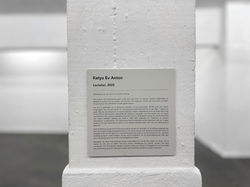
Lactatio!, 2025
Imagination, time, cultural or artistic institution
Display setup: wall label (print on aluminum), spotlights directed toward an empty space, granite bench from public space
Courtesy of the artist
images © Katya Ev Anton, Joost Joossen / We Document Art
view of the solo exhibition Lactating Bodies 20251031-0201, CC Strombeek (Be), 2025
PROJECT NOT SUPPORTED BY THE ART CENTER AND TRANSFORMED INTO A CONCEPTUAL WORK TO BE IMAGINED
Wall label:
"A lactating person is invited by a cultural or artistic institution to be remunerated for breastfeeding their child. They are employed with a contract that includes all social benefits guaranteed by labor law.
The remuneration rate is based on state-regulated salary scales : €2,800 gross per month, converted to an equivalent for full-time availability, 24/7. When employer and social contributions are included, the total cost would amount to €14,217.84 to remunerate a single lactating person for one month. The contract relies on Article 1bis of the Belgian Social Security Act, a unique legal mechanism created in 1969 to protect “atypical and precarious workers.” This mechanism provides artists with social security even in the absence of subordination or a traditional employment contract, enabling them to be recognized as employees.
This calculation highlights the immense economic scale of concealed and invisibilized care labor, revealing the contradictions within our society in its recognition and remuneration. By proposing to integrate lactating individuals into the payroll of a public institution, Lactatio!, a magic formula, turns the exhibition into a site of contractual void and imaginative space.
Visitors are invited to sit on the bench, to take their time, and to imagine how such a situation might have come into being. The work is conceived as a method, a practice, and a space for reflection, situated at the intersection of performance, protocol, discursive proposition, administrative practice, and legal research". Katya Ev Anton with advice of Azad Asifovich, Tobias Van Royen
_____________________________________________________________________________________
MILK TIES? CONTRACTUALIZING BREASTFEEDING
In Lactating Bodies, artist Katya Ev suggests a radically different kind of social contract: one not based on abstract rights or sovereign power, but on human milk. This is not a classic version of European political philosophy, where rational individuals agree to surrender certain freedoms in exchange for order and protection. Nor is it a contract in the conventional legal sense—a binding promise guaranteed by public authority. Ev instead invites us to consider a new kind of agreement: embodied and profoundly relational.
As legal scholar Elizabeth Emens notes, “Contract law is a rather amazing area of law. It is the legal domain where two people, by themselves, without any official status or special institutional authority, can design their own legally enforceable ruless” (Bound, 2025). Ev extends this idea beyond enforceable law and into the speculative realm. At the heart of such artistic practice lies a fictional contract, an experiential provocation that invites us to imagine what it would mean to compensate someone for the labor, time, and physical effort required to produce milk.
This made up contract falls within what Emens calls “extra-legal contracts”: agreements that take effect not through legal enforcement, but through their meaning, critical charge, and imaginary. These speculative frameworks challenge dominant structures that define labor and ascribe it its value. In Ev’s work, participants are invited to sit on a stark granite bench and reflect on the formalities of a hypothetical labor contract between a breastfeeding person and a cultural or artistic institution, with no artistic or other form of compensation expected. This recalls Ev’s 2021 performance Do Nothing, in which visitors were paid minimum wage to do nothing. By evoking the language and form of contract law, Ev situates the work both within a lineage of artists who use legal aesthetics as critique and within the history of breastfeeding as the contractual service of a wet nurse.
Breastfeeding has long been governed by contracts, implicit or explicit, official or informal. Mothers are expected to nurse their children without pay or formal recognition, participating in a broader system of unpaid reproductive labor. Alongside this, actual wet nurse contracts existed, such as those in Renaissance Florence. These agreements, often made between the father of the nursed child and the husband (or other male relative) of the wet nurse, dictated the terms of such exchange: pay, duration, living conditions, and rules of conduct. Throughout European history, from the Middle Ages to the 20th century, breastfeeding contracts were also used by hospitals, institutions for abandoned or fostered children, and even slave systems. Their conditions were generally imposed by men, as legal regimes like coverture or slavery prevented women from taking control of their own bodies, let alone entering into contracts or owning property in their names.
Drawing from this legacy, Lactating Bodies calls for a rethinking of today’s breastfeeding contract. In a world where wet-nursing has almost disappeared and where the social contract urges women to breastfeed freely, Ev’s intervention revives a forgotten history and asks: what might a fair and contemporary breastfeeding contract look like? What would it mean to materially recognize and support the labor of those who breastfeed?
By formalizing this imagination, Ev’s work ties the viewer to a new relationship with milk and care. It suggests a form of lactational kinship, inviting us to reflect: what are we, individually and collectively, willing to do to support those who feed the most vulnerable among us? How might we build a society that does not exploit breastfeeding, but honors it? Mathilde Cohen
Body of works "Lactating Bodies"


_view%20galleryG.jpg)
%2C%20color%20etching%20(gravure)-2%C2%A9%EF%B8%8FKatya%20Ev%20Anton_edited_edited.jpg)
%2C%20print%2C%20lightbox%C2%A9%EF%B8%8FKatya%20Ev%20Anton.jpg)
%2C%20print%20on%20poster%20paper%C2%A9%EF%B8%8FKatya%20Ev%20Anton.jpg)
%2C%20print%20on%20poster%20paper-left%C2%A9%EF%B8%8FKatya%20Ev%20Anton.jpg)
%2C%20graffiti%20on%20levkas%C2%A9%EF%B8%8FKatya%20Ev%20Anton.jpg)

%2C%20carrara%20marble%C2%A9%EF%B8%8FKatya%20Ev%20Anton.jpg)
%2C%20oil%20pastel%20on%20paper%C2%A9%EF%B8%8FKatya%20Ev%20Anton.jpeg)


%2C%20oil%20pastel%20on%20paper%2C%20detail%C2%A9%EF%B8%8FKatya%20Ev%20Anton.jpg)


Related exhibitions
.jpg)

_view%20galleryG.jpg)
Solo exhibition Lactating Bodies 20251031-0201, 2025
Group exhibition Over my (dead) body, 2019